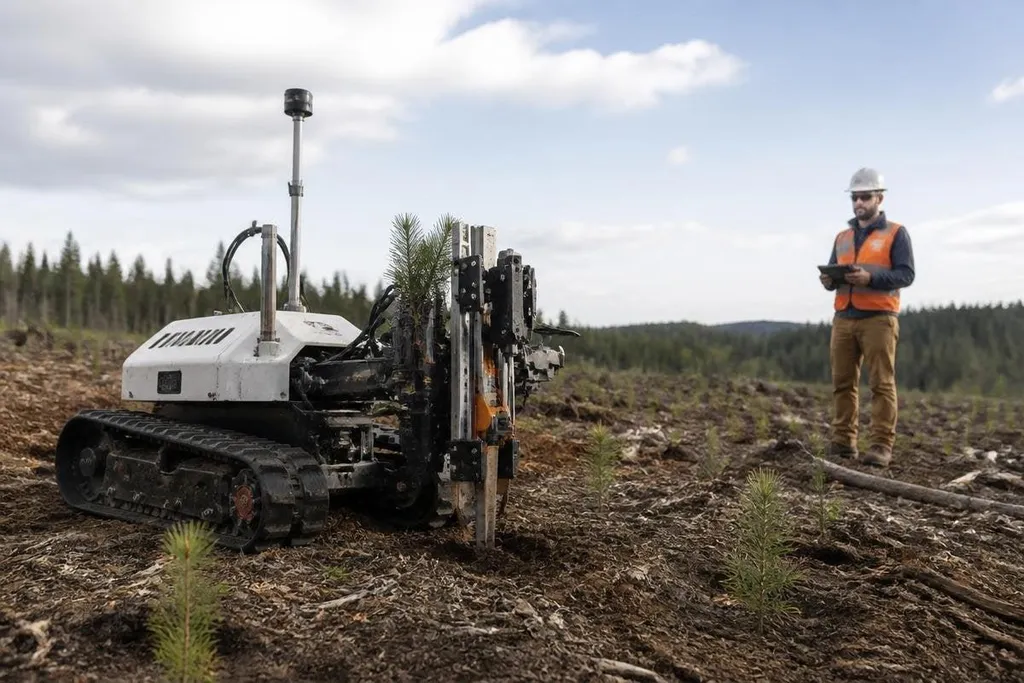
A tree-planting robot has a job that starts with digging and ends years later. The seedling must sit at the right depth, keep its roots covered, and survive the first dry season. That makes field results more useful than a fast planting video.
- A planting robot must read soil, terrain, and the space around each tree.
- The work needs a drill or planting tool, a seedling gripper, and soil control.
- Survival rate matters more than the number of seedlings placed in one day.
What the robot has to do
A working system must first move across rough ground without crushing existing plants or getting stuck. It then needs to find a safe planting spot.
The robot must make a hole, place the seedling, press soil around the roots, and record what happened. That sequence sounds simple until the ground changes.
A robot may meet rocks, roots, slopes, loose soil, wet ground, or a gap between planned planting points. Its sensors must spot these conditions before the planting tool starts.
Cameras can help identify seedlings, grass, and open ground. LiDAR measures distance with laser pulses, which helps the robot build a view of nearby objects. Satellite positioning can mark rows, but it may not be accurate enough on its own beneath thick tree cover.
The planting tool also needs feedback. A drill motor can show when the soil becomes harder, while force sensors can tell the gripper when a seedling is held firmly enough. Without that information, the robot can place a tree in a hole that is too shallow, too deep, or too loose.
The hard part comes after planting
A planted seedling can look fine when the robot leaves. Its roots may still have poor contact with the soil, or the stem may sit at an angle that exposes it to wind. A field team needs records that connect each planting point with the tree type, planting time, depth, and later condition.
That record turns a machine task into a measurable field result. Managers can return to weak areas, compare planting methods, and see whether a robot worked better on one soil type than another.
The useful report follows that number past the planting pass. Robot24.com tree-planting coverage can tie a robot’s count to soil, slope, battery stops, and the later site visit. That record keeps a high daily total from standing in for healthy trees.
A planting count still has value. It tells you how much ground the system can cover before its battery needs charging, its seedling tray needs loading, or a person must clear a fault. It says little about tree survival unless the operator checks the site later.
Where the race gets difficult
The robot must carry enough seedlings and power without becoming too heavy for soft ground. A large machine may cover more ground per trip, then cause ruts that damage the site. A small machine may protect the soil but need more trips and more human support.
Autonomy creates another limit. A system that works well on a marked test plot may stop often in a forest, where roots and branches block movement. Remote control can keep the work going, but it shifts part of the job back to a human operator.
Weather adds a separate problem. Rain changes soil grip and hole shape. Dry ground can raise drilling force and dust. Cold can cut battery runtime. Any claim about planting speed needs the soil, slope, weather, and number of human interventions beside it.
A practical buying checklist
Before paying for a tree-planting robot, check these points:
- Planting method: Does it use a drill, a blade, or another tool suited to your soil?
- Seedling handling: Can the gripper hold the types and sizes you plan to plant?
- Site records: Does the system save planting points, depth, tree type, and faults?
- Human work: How often must someone reload seedlings, clear jams, or guide the robot?
- Ground limits: Which slopes, rocks, roots, and soil conditions stop the machine?
- Long-term proof: Are survival results available after one growing season or more?
I'd judge any planting robot by the trees still growing after its first year, not by its fastest run. The next useful benchmark is a public field record linking planting rate to survival, soil type, weather, and human support.